Where Are We in the Nashville Retail Market Cycle?

As anyone who follows commercial real estate in the business journals probably already knows, Nashville retail real estate is moving differently than most U.S. markets. Retail has been the most stable property type nationwide for years now; however, in Music City, with new per-SF sales records most every quarter, we’ve been singing an especially upbeat tune. Our team at Lee Nashville always looks to the Burns School Market Cycle Reports (University of Denver) for a clean, data-driven read on where things stand. Paired with what we’re seeing on the ground in Middle Tennessee, the picture is quite clear: Nashville’s retail market is steady (sprinkled with occasional, grand-slam home runs), disciplined, and—importantly—still full of opportunity for owners and retailers who know how to navigate this phase of the cycle.
So… where exactly are we in the cycle?
Nashville Retail Today: Solidly in Expansion Mode
The last few years across Middle Tennessee tell a consistent story: retail is one of the strongest, tightest product types in the Nashville region. While office continues to struggle and multifamily has its challenges, Nashville retail has benefited from:
Very limited new construction, especially inside the urban core
Population growth and in-migration, which continue to fuel retail demand
A strong mix of necessity-based, service-oriented, and experiential tenants that outperform national averages
From the Burns School reports—combined with Nashville’s local data—the retail sector sits comfortably in a slow-but-steady expansion phase. We’ve been at the market-cycle sweet spot quarter-over-quarter for years now (in fairness, retail in most of the rest of the country has been as well). In practical terms for our market:
Vacancies are exceptionally tight, particularly in established corridors like Green Hills, Brentwood, Berry Hill, East Nashville, and Franklin.
Rents continue to rise, often more aggressively in prime submarkets.
Space is extremely competitive, with well-located centers leasing faster than new supply can enter the pipeline.
Construction remains constrained by high costs and limited land opportunities—both in Davidson County and in some of the outlying suburbs where city planners are now attempting to slow growth.
In other words, Nashville retail is very steadily and consistently winning.

Recent Quarters: What the Data Is Telling Us (Nashville Edition)
Q4 2023 → Q1 2024: Stabilization in Core Submarkets
Neighborhood and community centers in Franklin, Brentwood, Bellevue, and Hermitage continued to outperform.
Power centers remained strong thanks to discounters and value retailers expanding across suburban submarkets.
Consumer spending in the Nashville MSA held up despite inflation, buoyed by continued job and population growth.
Landlords maintained pricing power with almost no new competing centers coming online.
Q1 2024 → Q2 2024: Slow, Steady Strength Across the Region
Leasing velocity remained steady, particularly among national tenants targeting high-growth areas (Mt. Juliet, Murfreesboro, Spring Hill).
Experiential tenants—fitness, food, entertainment, recreational uses, med-retail—were some of the most active across Middle Tennessee.
Investor confidence strengthened for grocery-anchored and well-located neighborhood centers.
Q2 2024 → Q3 2024: Clear Flight to Quality in Nashville
The gap widened between renovated, high-visibility centers and older product stuck in 1990s layouts.
Class A retail saw above-trend rent growth; B/C assets were stable but flat unless modernized.
Capital flows favored Nashville retail as investors sought markets with strong population and job fundamentals.
Retail fundamentals stayed strong even as broader CRE sentiment softened nationally.
Q3 2024 → Q1 2025: A Measured, Competitive Nashville Market
Landlords enjoyed strong occupancy across nearly all submarkets.
Rent growth moderated but remained positive.
Retailers focused on “right-sizing,” chasing Nashville’s highest-performing corridors rather than expanding broadly.
Mixed-use districts (Fifth + Broadway, Capitol View, The Nations projects, etc.) and everyday-needs centers continued to attract the most traction.
Everyone continued to gear up in anticipation for what’s to come along the East Bank.
Across these quarters, Nashville retail behaved the same way: stable, disciplined, resilient.

Why Nashville Retail Is Outperforming
1. Limited New Construction = Significant Landlord Advantage
Nashville’s construction slowdown has been even more pronounced than national trends due to:
high construction and land costs
zoning constraints
scarce infill development opportunities
With virtually no new supply, existing centers have meaningful pricing power.
2. Nashville Consumers Are Still Spending—Just Differently
Population and income growth soften the impact of inflation. Spending on food, services, fitness, entertainment, med-retail, and value concepts remains strong—directly benefiting the centers dominating Nashville demand.
3. Retail Has Already “Right-Sized”—Nashville Even More So
Nashville avoided the over-building of the 2000s. Today’s retail footprint is lean, modern, and aligned with lifestyle-driven, convenience-driven consumer habits.
4. Retail Is Highly Local, Especially Here
Nashville’s “shop local” culture is strong—boosting small-shop tenancy in neighborhoods like 12 South, East Nashville, Germantown, and Sylvan Park.
So… Where Are We in the Cycle?
Using classic Mueller Cycle terminology, Nashville retail continues to rest comfortably at the coveted #11 spot of Phase 2, Expansion: Equilibrium.
We’re past recovery, solidly in expansion, and nowhere near oversupply. Development brakes across Middle Tennessee prevent overheating.
That means:
Demand is strong.
Supply is constrained—structurally and financially.
Rents are rising.
Vacancy remains low.
Developers can’t get ahead of the market, even when they want to.
This creates one of the most favorable local retail environments we’ve seen in more than a decade.
What This Means for Nashville Owners, Tenants & Investors
For Owners
This is a strong moment to:
push rents (modestly but confidently)
backfill vacancy with higher-quality tenants
modernize centers to compete with A-class mixed-use environments
prepare for refinances backed by solid fundamentals
For Retailers / Tenants
Expect tighter space conditions—especially in constrained submarkets like Green Hills, Berry Hill, Brentwood, and Cool Springs.
Early site selection is key; waiting means losing the location.
For Investors
Nashville retail continues to offer an exceptionally attractive risk-adjusted profile.
The best opportunities lie in:
well-located centers with modernization upside
neighborhood centers with strong demographic fundamentals
small-shop value-add plays in emerging submarkets
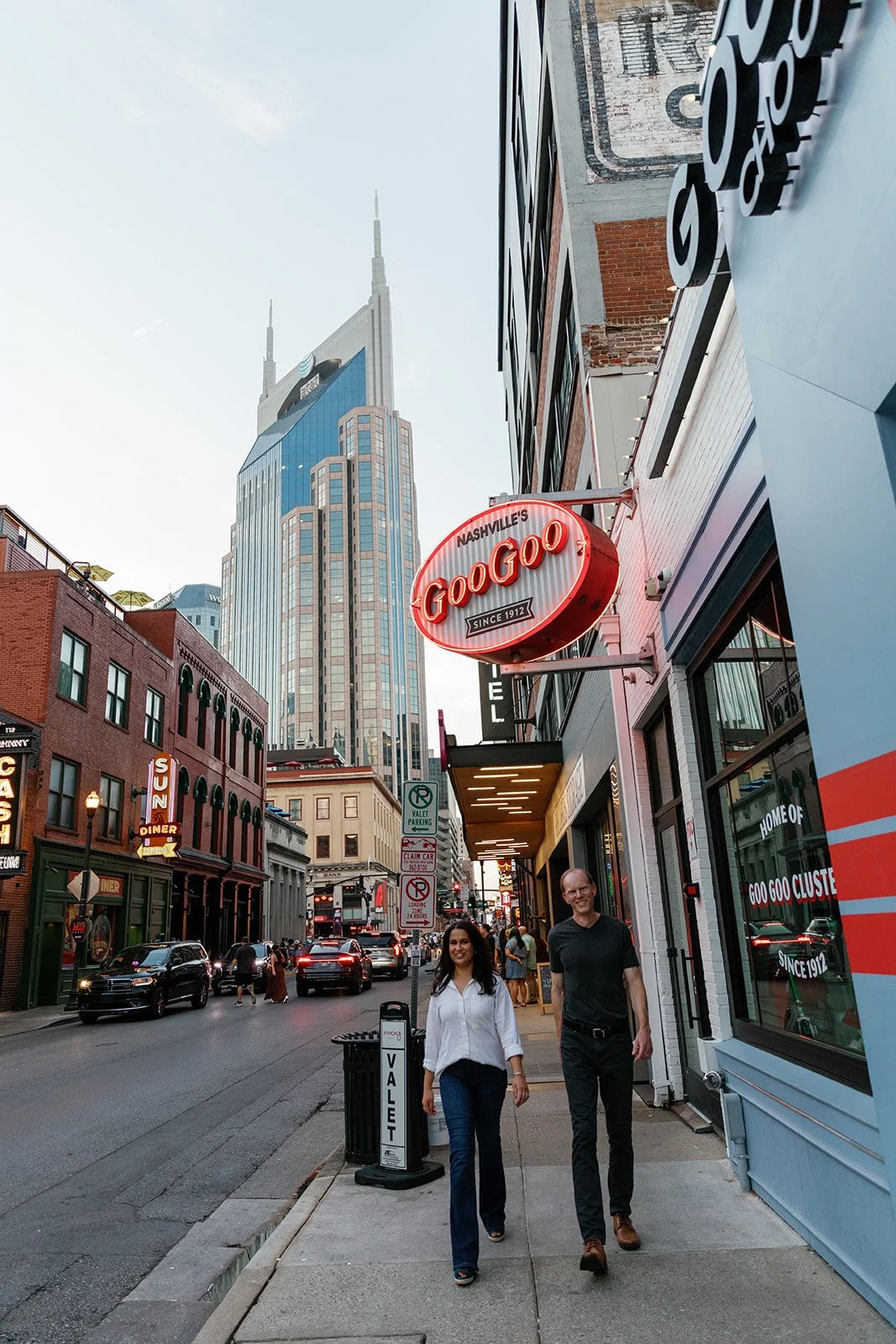
Downtown Nashville
Final Takeaway
Nashville retail is in one of its healthiest cycles in more than a decade.
The last several quarters reinforce a clear narrative: slow, disciplined, sustained (and occasionally flashy) growth.
And the Nashville shops, centers, and corridors that win will be those aligned with how real people in Middle Tennessee live today: local, experiential, convenient, and essential.
If you want help understanding what this cycle means for your center, your portfolio, or your next expansion, The Retail Team is here to help.